

When Was The Pager Invented

A pager (also known as a beeper or bleeper [i]) is a wireless telecommunications device that receives and displays alphanumeric or voice messages. Ane-mode pagers tin can only receive messages, while response pagers and two-way pagers can also admit, answer to and originate messages using an internal transmitter.[2]
Pagers operate as part of a paging system which includes i or more than fixed transmitters (or in the case of response pagers and 2-way pagers, one or more base of operations stations), as well as a number of pagers carried past mobile users. These systems tin range from a restaurant system with a unmarried low power transmitter, to a nationwide system with thousands of loftier-power base of operations stations.
Pagers were developed in the 1950s and 1960s,[3] and became widely used by the 1980s. In the 21st century, the widespread availability of cellphones and smartphones has profoundly macerated the pager manufacture. Nevertheless, pagers proceed to exist used by some emergency services and public rubber personnel, because modern pager systems' coverage overlap, combined with use of satellite communications, can make paging systems more reliable than terrestrial based cellular networks in some cases, including during natural and man-made disasters.[4] This resilience has led public condom agencies to adopt pagers over cellular and other commercial services for disquisitional messaging.[v] [half dozen]
In Japanese, it was commonly chosen a pocket bell (ポケットベル, poketto beru) or pokeberu (ポケベル),[7] which is an example of wasei-eigo.
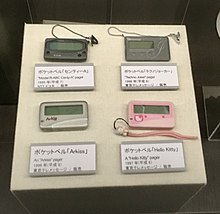
Four historical Japanese pagers.
History [edit]

An NEC pager branded by Deutsche Telekom for the Skyper pager service

Original Motorola "Pageboy II" pager, used in New York in the late 1970s.
The first telephone pager organization was patented in 1949 by Alfred J. Gross.[8]
One of the first applied paging services was launched in 1950 for physicians in the New York Metropolis area. Physicians paid US$12 per month for the service and carried a 200-gram (7 oz) pager that would receive phone letters within 40 kilometres (25 mi) of a unmarried transmitter tower. The system was manufactured by the Reevesound Company and operated by Telanswerphone.[9] In 1960, John Francis Mitchell combined elements of Motorola's walkie-talkie and car radio technologies to create the first transistorized pager,[10] [11] [12] and from that time, paging technology continued to advance and pager adoption among emergency personnel is nonetheless popular equally of July 2016.[thirteen]
In 1962, the Bong Arrangement, the U.S. telephone monopoly, presented its Bellboy radio paging organization at the Seattle World's Fair. Bellboy was the first commercial system for personal paging. Information technology as well marked i of the outset consumer applications of the transistor (invented past Bell Labs in 1947), for which iii Bell Labs inventors received a Nobel Prize in Physics in 1956. Solid-land circuitry enabled the Bellboy pager, about the size of a small TV remote device, to fit into a customer's pocket or bag, quite a feat at that time. The Bellboy was a terminal that notified the user when someone was trying to telephone call them. When the person received an aural signal (a buzz) on the pager, the user found a phone and called the service centre, which informed the user of the caller'southward message. In the mid-1980s, tone and vox radio paging became popular amidst emergency responders and professionals. Tone and vocalisation pagers were activated either by a local base station, or through a telephone number assigned to each individual pager. Bell System Bellboy radio pagers each used three reed receiver relays, each relay tuned to one of 33 different frequencies, selectively ringing a particular customer when all 3 relays were activated at the same time—a precursor of DTMF.[xiv] The ReFLEX protocol was developed in the mid-1990s.
While Motorola appear the end of its new pager manufacturing in 2001,[15] pagers remained in utilise in large hospital complexes.[16] First responders in rural areas with inadequate cellular coverage are often issued pagers[ citation needed ].
The 2005 London bombings resulted in overload of TETRA systems by the emergency services and showed that pagers, with their absence of necessity to transmit an acknowledgement before showing the message, and the related capability to operate on very low point levels, are not completely outclassed by their successors.[17] Volunteer firefighters, European monetary system paramedics and rescue squad members usually carry pagers to alarm them of emergency call outs for their department. These pagers receive a special tone from a fire department radio frequency.
Restaurant pagers were in wide use in the 2000s. Customers were given a portable receiver that would usually vibrate, wink, or beep when a tabular array became gratuitous or when their meal was ready. Pagers have been pop with birdwatchers in U.k. and Republic of ireland since 1991, with companies Rare Bird Alert and Birdnet Information offering news of rare birds sent to pagers that they sell.[19] [20]
The U.S. paging manufacture generated $2.1 billion in revenue in 2008, down from $6.two billion in 2003.[21] In Canada, 161,500 Canadians paid $18.5 meg for pager service in 2013. Telus, one of the iii major mobile carriers, appear the end to its Canadian pager service as of 31 March 2015, but rivals Bell, Rogers and PageNet intend to keep service.[fifteen]
Today, companies like Visiplex offering similar solutions for onsite pager systems in the medical, education and commercial sectors.
Refuse [edit]
The Britain National Health Service is thought to utilise over ten% of remaining pagers in 2017 (130,000),[16] with an annual cost of £6.half dozen million.[22] Matt Hancock, (and then) Secretary of State for Health and Social Intendance, announced in February 2019 that the 130,000 pagers still in use were to be phased out.[23] NHSX announced plans in May 2020 to replace pagers and bleepers with "more modern advice tools," accelerated by the pressure placed on the service past the COVID-19 pandemic in England.[24] In August 2020, a new procurement framework for clinical communications was launched which is intended to phase out pagers by the terminate of 2021, replacing them with "dedicated clinical-facing communication and tasks management tools" from 25 approved suppliers.[25]
In Japan, more x million pagers were active in 1996.[3] On i October 2019, Japan's last paging service provider shut downwards radio signals and terminated its service.[3]
Pattern [edit]
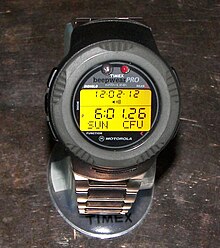
Timex Datalink Beepwear Pro: a wear pager/picket featuring alphanumeric paging capability. Part of the Timex Datalink family of watches
Many paging network operators now allow numeric and textual pages to be submitted to the paging networks via electronic mail. A significant convenience for users given the widespread adoption of electronic mail, and commonalities in delivery assurances. This tin result in pager letters being delayed or lost. Older forms of message submission using the Telelocator Alphanumeric Protocol involve modem connections directly to a paging network and are less bailiwick to these delays. For this reason, older forms of message submission retain their usefulness for disseminating highly-important alerts to users such equally emergency services personnel.
Common paging protocols include TAP, FLEX, ReFLEX, POCSAG, GOLAY, ERMES and NTT. Past paging protocols include Two-tone and 5/6-tone. In the United States, pagers typically receive signals using the FLEX protocol in the 900 MHz band. Commercial paging transmitters typically radiate thou watts of effective ability, resulting in a much wider coverage expanse per tower than a mobile phone transmitter, which typically radiates around 0.6 watts per channel. Although 900 MHz FLEX paging networks tend to have stronger in-building coverage than mobile phone networks, commercial paging service providers will work with large institutions to install repeater equipment in the upshot that service is not available in needed areas of the subscribing institution'due south buildings. This is specially critical in hospital settings where emergency staff must exist able to reliably receive pages to answer to patient needs.
Dissimilar mobile phones, most i-fashion pagers exercise not brandish whatever information about whether a bespeak is being received or most the strength of the received point. Since i-way pagers practise non contain transmitters, ane-way paging networks have no way to rails whether a bulletin has been successfully delivered to a pager. Considering of this, if a 1-way pager is turned off or is not receiving a usable indicate at the time a bulletin is transmitted, the bulletin will not be received and the sender of the message will not exist notified of this fact. In the mid-1990s, some paging companies began offering a service, which immune a customer to phone call their pager-number and take numeric messages read back to them. This was useful for times when the pager was off or out of the coverage area, as it would know what pages were sent to the subscriber even if the subscriber never actually received the page. Other radio bands used for pagers include the 400 MHz band, the VHF band and the FM commercial broadcast band (88–108&MHz). Other paging protocols used in the VHF, 400 MHz UHF and 900 MHz bands include POCSAG and ERMES. Pagers using the commercial FM band receive a subcarrier, called the Subsidiary Communications Authority, of a broadcast station. On-site paging systems in hospitals, unlike broad area paging systems, are local area services. Hospitals commonly use on-site paging for communication with staff and increasingly for contacting waiting patients when their date is due. These offering waiting patients the opportunity to go out the waiting area, but still be contacted.
Operation [edit]

The top of a Motorola "Bravo" numeric pager
Paging systems are operated by commercial carriers, often every bit a subscription service and they are also operated directly by stop users as individual systems. Commercial carrier systems tend to cover a larger geographical area than private systems, while individual systems tend to cover their limited surface area more thoroughly and deliver messages faster than commercial systems. In all systems, clients send letters to pagers, an action commonly referred to as paging. Organisation operators oft assign unique telephone numbers or email addresses to pagers (and pre-divers groups of pagers), enabling clients to page past telephone telephone call, eastward-postal service and SMS. Paging systems also support various types of direct connection protocols, which sacrifice global addressing and accessibility for a dedicated communications link. Automated monitoring and escalation software clients, often used in hospitals, Information technology departments and alert companies, tend to prefer direct connections because of the increased reliability. Small paging systems, such as those used in restaurant and retail establishments, ofttimes integrate a keyboard and paging organization into a single box, reducing both cost and complication.
Paging systems support several popular direct connectedness protocols, including TAP, TNPP, SNPP and WCTP, too every bit proprietary modem- and socket-based protocols. Additionally, organizations often integrate paging systems with their Voice-mail and PBX systems, conceptually attaching pagers to a telephone extension and set up web portals to integrate pagers into other parts of their enterprise. A paging system alerts a pager (or group of pagers) by transmitting data over an RF channel, including an accost and message data. This data is formatted using a paging protocol, such every bit 2-tone, 5/6-tone, GOLAY, POCSAG, FLEX, ERMES, or NTT. Two-way pagers and response pagers typically use the ReFLEX protocol.
Modern paging systems typically apply multiple base of operations transmitters to modulate the aforementioned signal on the aforementioned RF channel, a design approach called simulcast. This type of pattern enables pagers to select the strongest bespeak from several candidate transmitters using FM capture, thereby improving overall organisation performance. Simulcast systems often use satellite to distribute identical data to multiple transmitters and GPS at each transmitter to precisely fourth dimension its modulation relative to other transmitters. The coverage overlap, combined with use of satellite communications, can make paging systems more reliable than terrestrial based cellular networks in some cases, including during natural and homo-fabricated disaster.[4] This resilience has led public safety agencies to adopt pagers over cellular and other commercial services for critical messaging.[5] [6]
Categories [edit]
Pagers themselves vary from very cheap and elementary beepers, to more than complex personal communications equipment, falling into eight main categories.
- Beepers or tone-simply pagers
- Beepers or tone-only pagers are the simplest and least expensive form of paging. They were named beepers considering they originally made a beeping noise, but electric current pagers in this category use other forms of alert every bit well. Some utilize audio signals, others low-cal up and some vibrate, oft used in combination. The bulk of restaurant pagers autumn into this category.
- Vocalisation/tone
- Voice/Tone pagers enable pager users to listen to a recorded voice message when an alarm is received.
- Numeric
- Numeric Pagers contain a numeric LCD display capable of displaying the calling phone number or other numeric data by and large upward to 10 digits. The display can also convey pager codes, a set of number codes corresponding to mutually understood pre-defined messages.
- Alphanumeric
- Alphanumeric pagers contain a more sophisticated LCD capable of displaying text and icons. These devices receive text messages, often through e-mail or directly connection to the paging arrangement. The sender must enter a bulletin, either numeric and push # or, text & push # or a exact message. The pager does non automatically record the sender's number; the pager will beep merely no message tin can be seen or heard if none has been entered.
- Response
- Response pagers are alphanumeric pagers equipped with congenital-in transmitters, with the power to acknowledge/confirm messages. They too allow the user to respond to messages by way of a multiple-choice response list, and to initiate "canned" letters from pre-programmed address and message lists. These devices are sometimes called "ane.5-way pagers" or "1.7-way pagers" depending on capabilities.
- Two-manner
- Two-style pagers are response pagers with built-in QWERTY keyboards. These pagers allow the user to reply to letters, originate letters and forward letters using costless-course text equally well as "canned" responses.
- One-style modems
- One-way modems are controllers with integrated paging receivers, which are capable of taking local action based on messages and data they receive.
- Two-manner modems
- 2-manner modems take capabilities similar to 1-way modems. They can also confirm letters and transmit their own messages and information.
Security [edit]
Pagers also have privacy advantages compared with cellular phones. Since a one-way pager is a passive receiver merely (it sends no information dorsum to the base station), its location cannot be tracked. Even so, this can likewise be disadvantageous, equally a message sent to a pager must exist broadcast from every paging transmitter in the pager's service expanse. Thus, if a pager has nationwide service, a message sent to it could be intercepted past criminals or constabulary enforcement agencies anywhere within the nationwide service surface area.
In popular civilization [edit]
Every bit is the case with many new technologies, the functionality of the pager shifted from necessary professional employ to a social tool integrated in one'due south personal life. : 175 During the rise of the pager, it became the bailiwick of diverse forms of media, most notably in the 1990s hip-hop scene. Upcoming mainstream artists such as Water ice Cube, Method Homo and A Tribe Called Quest began referencing forthcoming mobile technologies, in particular the pager. A Tribe Called Quest's single "Skypager" directly speaks of the importance of such a wireless communication device. "Q-Tip" conveys that the Skypager "serves an important chatty role for a young professional with a full calendar." Three half dozen Mafia's "2-Way Freak," Sir Mix-A-Lot'southward "Beepers" and "Bug a Boo" from Destiny'due south Child also brand reference to pagers. Illicit drug dealers used pagers to dandy effect during the 1990s to conduct commerce, using them to arrange meetings with buyers. Associate superintendent for Miami-Dade County Public Schools in Florida James Fleming once chosen them "the most dominant symbol of the drug trade" and schools have previously forbidden students from carrying them because of the ease with which they could be "used to arrange illegal drug sales."[27]
Meet as well [edit]
- Minitor
- Plectron
- Simple Network Paging Protocol
- Text messaging
- Wireless Communications Transfer Protocol
References [edit]
- ^ "BLEEPER | pregnant in the Cambridge English Dictionary". Dictionary.cambridge.org. 25 May 2022. Retrieved 31 May 2022.
- ^ "What is pager? – Definition". WhatIs.com.
- ^ a b c "Pager services to end Tuesday in Japan later l years". Japan Today. 30 September 2019. Archived from the original on 1 October 2019. Retrieved 1 Oct 2019.
- ^ a b Independent Panel Reviewing the Touch on of Hurricane Katrina on Communications Networks (12 June 2006). "Report and Recommendations to the Federal Communications Commission" (PDF). Federal Communications Commission. p. 24. Retrieved fourteen Jan 2018.
- ^ a b London Ambulance Service – Pager and SMS Procedure Archived 22 February 2014 at the Wayback Machine Section 3.0. March 2007.
- ^ a b NFPA 1221: Standard for the Installation, Maintenance, and Use of Emergency Services Communications Systems, 2002 edition, at 1221–23 section 8.4.ii.1
- ^ "Nippon'due south last pagers beep for the final time". BBC News. 1 October 2019. Retrieved 21 March 2021.
- ^ "When Pagers and Beepers Were All the Rage". thoughtco.com.
- ^ Corporation, Bonnier (one January 1951). Popular Science. Bonnier Corporation. p. 104 – via Internet Annal.
pop science 1950 can our jets support.
- ^ "John F. Mitchell Biography". brophy.net.
- ^ "The Elevation Giants in Telephony". historyofthecellphone.com. Archived from the original on 17 January 2013. Retrieved five November 2012.
- ^ "Who invented the cell phone?". brophy.net.
- ^ Apply of Pagers in Crunch Situations Archived 25 January 2011 at the Wayback Machine (Archive)
- ^ Keller, A. C. (1964), Recent Developments in Bell System Relays – Particularly Sealed Contact and Miniature Relays (PDF), The Bell System Technical Periodical [ permanent dead link ]
- ^ a b "Why the pager isn't dead yet".
- ^ a b "Old technology: NHS uses 10% of world's pagers at annual cost of £half dozen.6m". The Guardian. London. 9 September 2017.
- ^ "London Ambulance Service – Response to London Assembly 7 July Review Committee study". londonambulance.nhs.united kingdom of great britain and northern ireland.
- ^ "Rare Bird Alarm — Upgrade to the X3 Pager Today".
- ^ "BirdNet Pager".
- ^ AnythingResearch.com study on Paging Industry market size 2003 and 2008 research data used with permission
- ^ "NHS still reliant on 'primitive' fax machines". BBC News. 12 July 2018. Retrieved 12 July 2018.
- ^ "NHS told to ditch 'outdated' pagers". BBC. 23 February 2019. Retrieved 23 February 2019.
- ^ "Pandemic spurs NHS to 'urgently' speed up elimination of pagers". Wellness Service Journal. eleven May 2020. Retrieved 28 June 2020.
- ^ "New procurement framework helps stage out archaic pagers". Building Better Healthcare. 3 August 2020. Retrieved 19 September 2020.
- ^ Sims, Calvin (25 September 1988). "Schools Responding to Beeper, Tool of Today'due south Drug Dealer, by Banning It". The New York Times . Retrieved 16 February 2014.
External links [edit]

Wikimedia Commons has media related to Pagers.
- Note Page technical support—Technical information on protocols, carriers, etc.
- 800Beepers User Manuals [ permanent dead link ]
- 800Beepers Enhanced Options / Services

When Was The Pager Invented,
Source: https://en.wikipedia.org/wiki/Pager
Posted by: chapmanlusell.blogspot.com
0 Response to "When Was The Pager Invented"
Post a Comment